The convenient asphalt mastic (CAM) is prepared by the pretreatment process of cationic rapid setting emulsified asphalt (CRS-1) with cement. The CAM is then mixed with the aggregate to produce the convenient asphalt concrete (CAC) mixture. The pretreatment is to mix sulphonated naphthalene formaldehyde condensates (SNF) with emulsified asphalt evenly. In the pretreatment process, the SNF generates a protective barrier outside the electrical double layer on the surface of the emulsified asphalt micelles, which can inhibit the demulsification of micelles and improve the stability of CRS-1 in the CAM preparation. The residual SNF in the pretreatment proceeding can also be used as a water reducing agent, which can improve the workability of CAM and provide a dosage ratio that can increase the cement content. The increase of cement content in CAM can significantly improve the mechanical properties of CAC. The results of this study show that as the SNF pretreatment dosage increases, CAM viscosity decreases, and the CAC mixture has better workability. The Marshall stability value of the CAC obtained by CRS-1 (pretreated with SNF) can reach about six times that of hot mixture asphalt (HMA) at 28 days of age. The compressive strength can reach more than three times and the 40°C resilient modulus can reach more than eight times. Clearly, the modification effect of the pretreated CAC significantly enhances the mechanical performance.
This is an Open Access article, distributed under the terms of the Creative Commons Attribution 4.0 International License (http://creativecommons.org/licenses/by/4.0/), which permits unrestricted use, distribution and reproduction in any medium or format, provided the original work is properly cited.
Cement, Emulsified Asphalt, Water Reducer, Micelle Stabilization
1. Introduction
CAC is a mixture of CAM and aggregates. CAM contains cationic rapid setting emulsified asphalt (CRS-1), sulphonated naphthalene formaldehyde condensates (SNF), and Type-1 Portland cement.
Because CAC is mixed and constructed at normal temperature, carbon emission can be reduced. In addition, the aggregate and emulsified asphalt mixing process of CAC does not use combustion heating, but the emulsified asphalt is directly mixed with other dry materials after pretreatment, which can greatly reduce the generation of organic pollutants (VOC) and dust, avoid air pollution, and enable people to protect personnels both mixing plant and on-site construction. Reduce the inhalation of harmful substances and avoid heat damage caused by high temperature substances and the environment.
In addition, CAC improves the previous cement asphalt concrete that needs to be divided into two stages of compaction, so that the CAC construction process can be coherent. CAC can be compacted at one time, unlike traditional cement asphalt concrete, which needs to wait for emulsified asphalt to break and then the first stage of compaction going. Follow by the final compression rolling when cement of CAM acting the initial setting.
Convenient asphalt concrete has several times higher mechanical strength than hot mix asphalt concrete (HMA), which can ensure the stability of road surface structure, extend the service life, and reduce the frequency of maintenance. Because of CAC’s environmental protection, energy saving, safety, easier construction, with strong material strength and other benefits, it is named convenient asphalt concrete.
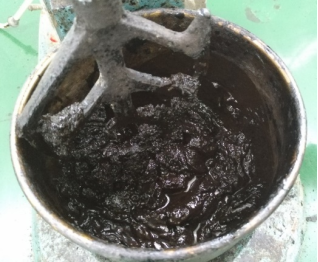
According to previous experience, the cement asphalt mastic is mixed with emulsified asphalt and cement. Unfortunately, the cement will destabilize and break the emulsified asphalt micelles, which may cause demulsification. The demulsified emulsified asphalt micelles will then cohere into the sticky asphalt glue, as shown in Figure 1. The viscosity of the mixture of the emulsified asphalt mixing with cement contributes to emulsified asphalt breaking is much greater than that of the originally emulsified state
[1]
Mihai O. Marasteanu and Timothy R. Clyne, 2006. “Rheological Characterization of Asphalt Emulsions Residues.” Journal of Materials in Civil Engineering, Volume 18 Issue 3, 398-407.
ZHU Xiaobin, HONG Jinxiang, LI Wei, Aug. 2017. “Effect of Demulsification Behavior of Emulsified Asphalt on Rheological Properties in CA Paste and Its Mechanism.” Journal of Building Materials, Vol. 20, No. 4: 548-555.
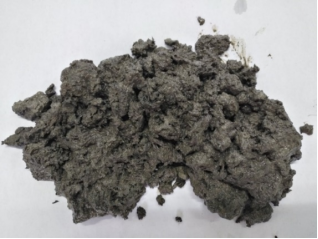
. As shown in Figure 2, the emulsified asphalt loses its workability after the cement was mixed the demulsification occurred.
Therefore, in this study, the SNF is uniformly mixed with CRS-1 first to increase the stability of the CRS-1 micelle, to ensure that the demulsification does not occur when the CRS-1 is mixed with the cement. This processing technique is called “pretreatment”.
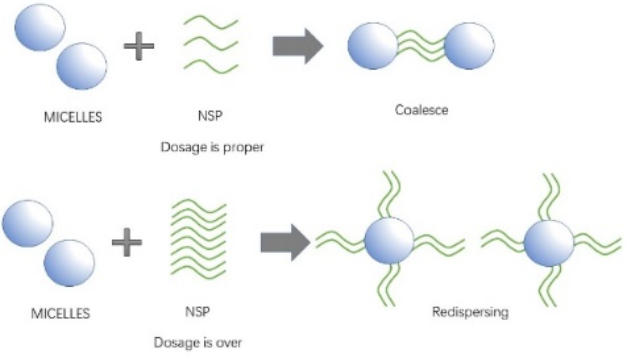
The stability of SNF to make the micelle comes from two aspects. The first aspect is to thicken the electrical double layer of the CRS-1’s micelle. When the SNF and CRS-1 are mixed, the molecules of the SNF will electrically attach to the surface of the micelle of the CRS-1 to form a barrier outside the electrical double layer, thicken it, and enhance the micelle stability. This double-electric layer can enhance micelle stability by increasing the mutual repulsive force of the homogeneity in the electric field between micelles; and hence, decrease the tendency of consolidation and aggregation, as shown in Figure 3
[3]
Ambarish Banerjee, Amit Bhasin, Jorge Prozzi, January 2013. “Characterizing Stability of Asphalt Emulsions Using Electrokinetic Techniques.” Journal of Materials in Civil Engineering, Volume 25, Issue 1 (78 - 85).
. The second aspect is that the SNF plays the septum role between the cement grain and the emulsified asphalt micelles. The SNF forms a layer on the CRS-1 micelles to isolate them from the cement grains, so that the emulsified asphalt will not adhere to the cement grains during the mixing process. This maintains the workability of the CAM mixture due to its low viscosity. Therefore, in addition to the electrical effect of the same ion mutual exclusion, there is also a molecular barrier effect for the overall stabilization mechanism of the pretreated CRS-1 micelles of the CAM. These two effects will inhibit the demulsification of CRS-1 micelles after SNF pretreatment and will maintain good workability for the CAM.
In this study, pretreated CRS-1 is mixed with the cement to produce CAM and then mixed with the aggregate to synthesize CAC. This special mixing process of treating the cement and the emulsified asphalt is novel and different from other similar studies
[5]
Xuepeng Cao, Cuihong Zhang, Shuaihua Tuo, Yao Fu, June 2021. “Influences on Compaction of Cold Mix Cement Emulsified Asphalt Using the Superpave Gyratory Compaction.” Journal of Materials in Civil Engineering, Volume 33, Issue 6.
Brown S F, Needham D, 2000. “A Study of Cement Modified Bitumen Emulsion Mixtures. ” Proceedings of the Association of Asphalt Paving Technologists, p. 92-121.
Oruc S, Celik F, Akpinar M V, 2007. “Effect of cement on emulsified asphalt mixtures.” Journal of Materials Engineering and Performance, 16(5): 578-583.
Andrea Grilli, Fabrizio Cardone, Edoardo Bocci, 2018. “Mechanical behaviour of cement-bitumen treated materials containing different amounts of reclaimed asphalt.” European Journal of Environmental and Civil Engineering, Volume 22, Issue 7 Pages 836-851.
in which cement and sand are mixed with the cationic slow setting emulsified asphalt (CSS), that contains CSS-1 or CSS-2, after adding the water to wet the cement or cement-sand mixture to synthesize the cement slurry or cement mortar.
In past studies associated with asphalt concrete, cement was used as a modifier (i.e., as a filler, an anti-stripping agent, or a strength enhancer). Generally, when cement is applied to an emulsified asphalt concrete mixture, there are two different mixing processes. One mixing process is to mix first the CSS, water, and aggregates together. The other mixing process is to mix the cement slurry with aggregates before adding the CSS
[9]
R. Schmidt, L. Santucci, L. Coyne, 1973. “Performance characteristics of cement-modified asphalt emulsion mixes.” Association of Asphalt Paving Technologists Proc, Volume: 42, pp. 300-319, Proceedings of the meeting held in Houston, Texas.
[10]
Y. Niazi, M. Jalili, 2009. “Effect of Portland cement and lime additives on properties of cold in-place recycled mixtures with asphalt emulsion.” Construction and Building Materials, Volume 23, Issue 3, March, Pages 1338-1343.
M. Bocci, A. Grilli, F. Cardone, A. Graziani, 2011. “A study on the mechanical behaviour of cement–bitumen treated materials.” Construction and Building Materials, Volume 25, Issue 2, Pages 773-778.
Mojtaba ShojaeiBaghini, AmiruddinIsmail, Mohamed RehanBin Karim, 2015. “Evaluation of cement-treated mixtures with slow setting bitumen emulsion as base course material for road pavements.” Construction and Building Materials, Volume 94, Pages 323-336.
. However, mixtures prepared by these two different processes require additional mixing water. In fact, the proportion of the cement blended is relatively low about the two different mixing processes, that is only 0.4 to 0.75 times when the cement/emulsified asphalt ratio is between 1 to 1.2, used in this study. Therefore, the CAC contributes to a significant enhancement in strength compared to the cement asphalt concrete of past studies (hereafter referred to as CAC of the past studies)
[13]
Jinhai Yan, Zhen Leng, Feng Li, Haoran Zhu, Shihui Bao, 2017. “Early-age strength and long-term performance of asphalt emulsion cold recycled mixes with various cement contents.” Construction and Building Materials, Volume 137, Pages 153-159.
Shaowen Du, 2018. “Effect of curing conditions on properties of cement asphalt emulsion mixture.” Construction and Building Materials, Volume 164, Pages 84-93.
Monica Meocci, Andrea Grilli, Francesca La Torre, Maurizio Bocci, 2017. “Evaluation of mechanical performance of cement–bitumen-treated materials through laboratory and in-situ testing.” Road Materials and Pavement Design, Volume 18, Issue 2, 376–389.
Bohdan Dolzycki, Mariusz Jaczewski, Cezary Szydlowski, 2017. “The long-term properties of mineral-cement-emulsion mixtures.” Construction and Building Materials, Volume 156, Pages 799-808.
At the past studies, during paving and initial compaction, the additional water of the CAC must be bleeded after emulsified asphalt demulsified. When this free water bled in the mixture pores by the compaction process, these pores can be reduced, and the pavement is compacted well. Therefore, after the initial compaction, there are about four hours of waiting time before the middle compaction and the final compaction can be carried out; and thus, the pavement compacting process cannot be performed continuously
[17]
LI Yuanyuan LI Chuangmin LIU An, 2015. “Study on Molding Methods and Compressive Strength of Cement-emulsified Asphalt Mixture with Coupling Agent.” Journal of Wuhan University of Technology, Vol. 39 No. 6, 1215-1220.
I Nyoman Arya Thanaya, I Nyoman Widana Negara, I Putu Suarjana, 2014. Properties of Cold Asphalt Emulsion Mixtures (CAEMs) using materials from old road pavement milling, Procedia Engineering, Volume 95, Pages 479-488.
. However, the CAC prepared in this study does not have this bleeding issue during pavement compacting since no additional water is required during the mixing process. Moreover, various mechanical properties of the CAC prepared in this study are also better than those of the cement asphalt concrete of the past studies
[13]
Jinhai Yan, Zhen Leng, Feng Li, Haoran Zhu, Shihui Bao, 2017. “Early-age strength and long-term performance of asphalt emulsion cold recycled mixes with various cement contents.” Construction and Building Materials, Volume 137, Pages 153-159.
Shaowen Du, 2018. “Effect of curing conditions on properties of cement asphalt emulsion mixture.” Construction and Building Materials, Volume 164, Pages 84-93.
Monica Meocci, Andrea Grilli, Francesca La Torre, Maurizio Bocci, 2017. “Evaluation of mechanical performance of cement–bitumen-treated materials through laboratory and in-situ testing.” Road Materials and Pavement Design, Volume 18, Issue 2, 376–389.
Bohdan Dolzycki, Mariusz Jaczewski, Cezary Szydlowski, 2017. “The long-term properties of mineral-cement-emulsion mixtures.” Construction and Building Materials, Volume 156, Pages 799-808.
As a result, pretreatment of CRS-1 by the SNF inhibits the demulsification reaction caused by direct mixing with cement, which yields better workability for the CAM and better strength for both the CAM and the CAC.
Figure 3. SNF Ions Enhance the Mutual Exclusion of Electric Property between the Emulsified Asphalt Micelles, and Reduce the Tendency of Micelle Coalescence.
2. Experimental Program
2.1. Materials
The main materials used in this study meet the ASTM specifications shown in below:
1) ASTM C150 specifications for the material properties of the Type I Portland Cement.
2) ASTM C494 specifications for the sulphonated naphthalene formaldehyde condensates (SNF), as a strong water reducing agent for cement slurry.
3) ASTM 2397 specifications for the cationic rapid-setting emulsified asphalt (CRS-1), and the main physical properties of the experimental results are shown in Table 1.
4) The aggregate was granite, and it met the Fuller’s Curve grading distribution, as shown in Table 2.
To select the aggregate gradation, and since the appropriate mixing viscosity of CAM (1000~11000cPs, as shown in Figure 8) is greater than that of the typical asphalt viscosity in hot-mix asphalt (HMA) mixtures (170±20cPs), and since the thickness of the CAC aggregate covered by CAM is thicker than that of the aggregate covered by asphalt binder in the typical HMA, larger pores are needed to accommodate the CAM between the aggregate particles. Therefore, the aggregate grading in the CAC mixture is selected following the lower limit of the passing percentage of each sieve. Fine aggregates below the #200 sieve are removed to make the aggregates coarser and the pores between the aggregate particles larger.
Table 1. Results of CRS-1 Physical Property Tests.
Test Item
Standard Value
Laboratory Results
Residue by Distillation
Above 60%
57%
Storage Stability Test, 24 hours, %
Below 1
0.32
Static Stratification Test, 5 days, %
Below 5
0.91
Table 2. Aggregate Particle Size Distribution.
sieve mesh
passing% of specification
Measured Passing %
1”
100
100
3/4”
90-100
90
3/8”
56-80
60
No.4
35-65
40
No.8
23-49
23
No.50
5-29
5
No.200
2-8
2
Button
0
0
2.2. Pretreatment and Mixing Protocol
The pretreatment protocol used in this study is to mix first the CRS-1 and SNF uniform (at 3%, 4%, and 5% of CRS-1 by weight). Flocculation will appear at the initial stage of mixing, but it will disappear after continuous mixing. The cement is then added into pretreated CRS-1 to form the CAM, and finally, the CAC mixture is prepared when the appropriate amount of aggregate is added to the CAM. Table 3 shows the mixing dosages (SNF/CRS-1 and cement/CRS-1 ratios) to prepare the CAC mixture.
The mixing protocol to prepare the Convenient Asphalt Concrete (CAC) includes three steps, as summarized below:
1) CRS-1 and SNF are fully mixed until the flocculation disappears and then rest for two minutes.
2) The cement is added to the prepared mixture in step (1) and stirred for two minutes to form the CAM.
3) The coarse and fine aggregates are added to the CAM while keep stirring.
The CAC mixture is loaded into a steel mold and compacted, after aggregates are fully covered by the CAM, following ASTM D 1559 (Marshall test procedures).
Table 3. Proportion of Material Composition Used in CAM.
SNF/CRS-1
3%
4%
5%
Cement/CRS-1
1.0
1.1
1.2
2.3. Experimental Testing
2.3.1. Viscosity Testing
CAM viscosity was tested by the Brookfield viscosity meter following ASTM D4402, using the #6 spindle in a 60 RPM.
2.3.2. Mechanical Strength
In terms of compressive strength, Marshall stability value was measured following ASTM D1074 to assess the mechanical strength differences between the CAC of various mixtures dosages and the HMA, using specimens of 10 cm in diameter and 10 cm in height and aged for 8 hours to 28 days. The resilient modulus test was also performed following ASTM D4123 at 40°C to compare the mechanical properties between the pretreated CAC and the HMA mixture.
3. Results and Discussions
The most important procedure of the CAM pretreatment is to fully mix the SNF and CRS-1 first, so that CAM is in a stable state due to the thickened electrical double layer on the micelle of the CRS-1 formed by the SNF molecules, and the formation of a barrier outside of the micelles. The produced CAM has good stability and workability due to the electrical isolation and physical buffering between CRS-1 micelles and cement grains.
3.1. Relationship Between the Pretreated CRS-1 and the Zeta Potential
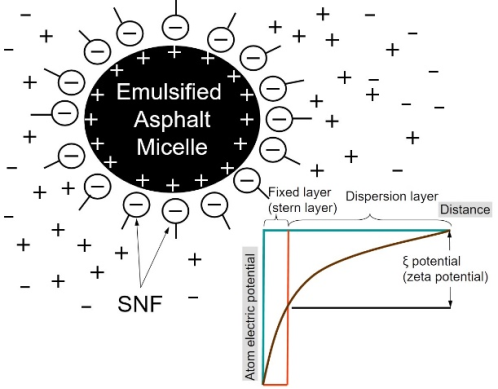
The electrical double layer is the former of the interfacial electric phenomenon of the static and the dynamic phenomena, and the Zeta potential is a dynamic phenomenon. According to the interfacial electric phenomenon, the surface of a tiny particle in a polar liquid (or solution) adsorbs the polar molecules (or ions) that are suspended in the liquid and they form the first (static) layer of charge (stern layer). Clearly, a potential difference appears between the solid surface and the liquid, as shown in Figure 4. This potential difference will attract other particles with opposite polarity to form the second (dynamic) layer of charge (dispersion layer) on the solid surface, and this concludes the electrical double layer of the interface. The overall potential difference is called the double-layer potential, where the potential difference is shown in Equation (1), and as shown in Figure 4.
(1)
where, ξ is the Zeta potential, δ is the electrical double layer thickness, σ is the charge density on the particle surface, and E is the dielectric constant of the polar liquid. Equation (1) is valid when the particle radius is much larger than the thickness of the electrical double layer, and it is consistent with this study.
In this study, the micelles of CRS-1 are in the Brownian motion, and the water molecules among the stern layer are also in motion, while the ions of the dispersion layer remain stationary. The potential difference across the dispersion layer is the Zeta potential of the suspended colloid.
Figure 4. Definition and Interpretation of the Electrical double layer Outside of the Micelle.
The larger the Zeta potential, the thicker the dispersion layer around the colloidal particles. This also means greater permissible overlapping thickness of the electrical double layer (i.e., the ionic diffusion layer) during the molecular collision, and lower probability of coalescence due to collision contact of micelles. As a result, the thicker the ionic diffusion layer, the higher the ionic density of the micelle surface, which gives a stronger surface electric field, as shown in Equation (2). Hence, the mutual repulsive force of the micelle particles is stronger when they collide with each other. This means the larger the Zeta potential, the more stable the dispersed state of the colloid, and the lower probability of micelle coalescence when colliding with each other
[19]
Jozua Laven, Hans N. Stein, 2001. “The Electroviscous Behavior of Aqueous Dispersions of Amorphous Silica (Ludox).” Journal of Colloid and Interface Science, Volume 238, Issue 1, Pages 8-15.
Hunter, R. J., 1981, Zeta Potential in Colloid Science., Academic Press, New York, pp. 107.
[21]
Adamson, A. W., 1990, Physical Chemistry of Surfaces., Wiley-Interscience, New York, pp. 72-73.
[19-21]
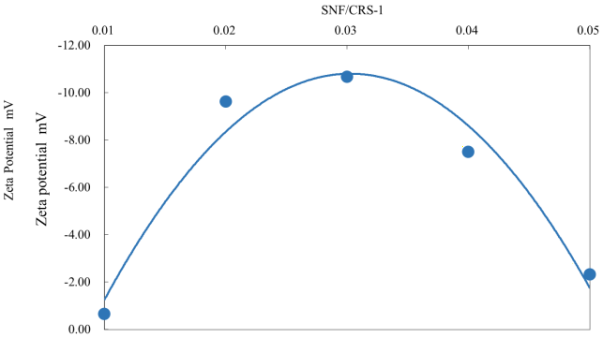
. Experimental results of this study verified that the Zeta potential increases with the increase of SNF dosage. An extreme value is obtained when the SNF/CRS-1 ratio reaches 0.03, as shown in Figure 5.
(2)
where, VR is the electric field intensity between particles, ε is the dielectric constant of the medium, r is the radius of the particle, ψ0 is the potential of the stern layer on the surface of the particle, K is the reciprocal of the thickness of the diffused electrical double layer, and H is the shortest distance between the particles’ surfaces.
As shown in Figure 5, the SNF dosage does affect the Zeta potential of micelles in the CRS-1, with the maximum value occurring at an SNF/CRS-1 ratio of 0.03. According to Equation (1), the electrical double layer thickness δ is at its largest value at that ratio. Subsequently, as the SNF dosage increases, the dispersion layer is neutralized by extra SNF molecules, and hence, the Zeta potential decreases. However, the optimal SNF dosage selected in this study is not 3% but 5%. The reason is that, in addition to providing stability protection for micelles, SNF also needs to offer the workability between CRS-1 and cement by providing a barrier on the micelle’s surface. Therefore, a higher SNF dosage (more than 3%) is required to lubricate the cement slurry in the CAM.
Figure 5. Trend of Zeta Potential of CRS-1’s Micelles after the SNF Pretreats CRS-1.
3.2. Relationship of the CRS-1 Pretreated by SNF and the CAM’s Viscosity
After adding the SNF to the cement slurry, and due to the negative ions -SO¯ and -COO¯ in the water, the water reducer will be adsorbed on the cement grains under the attraction of the cement positive charge Ca2+ and forms a electrical double layer on the surface. The cement grains are then dispersed under the influence of electrostatic repulsion, and the bound water in the mixture is released; thus, the cement slurry will have better fluidity. Moreover, the SNF is adsorbed on the cement grain’s surface, and it is associated with water molecules through the hydrogen bond to form a stable water film on the cement grain’s surface. This prevents the cement grains from coming into direct contact with each other, and hence, increases the sliding ability between the cement grains and improves the cement slurry fluidity
[22]
Vance H. Dodson, 1990, Concrete Admixtures, Springer Science + Business Media, New York, pp. 201.
[23]
Xinguo Zheng, Jing Liu, Zhi Zeng, Shuming Li, 2015. “Rheological Behavior, Segregation, Microstructure, and Construction Quality of Cement-Emulsified Asphalt Mortar with Associative Thickener.” Journal of Materials in Civil Engineering, Volume 27, Issue 11.
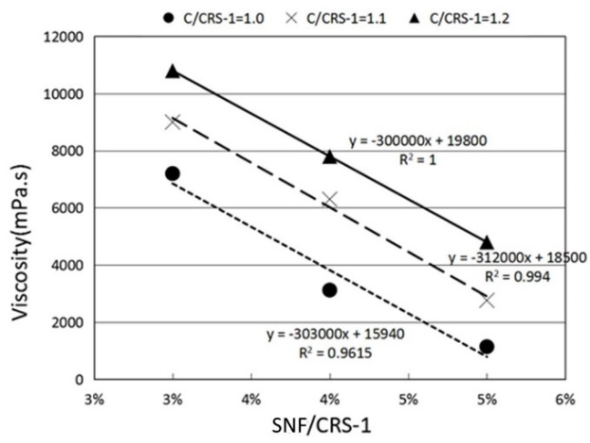
. In fact, the results of this study verified this tendency. As shown in Figure 6, the CAM’s viscosity decreases with the increase in SNF dosage. Clearly, CRS-1 pretreated by SNF can reduce the CAM’s viscosity and improve the CAC workability. That is, the use of SNF not only enhances the stability of CRS-1’s micelles but also decreases the CAM’s viscosity. This is beneficial to the workability of the CAC mixture.
Figure 6. Impact Trend of the SNF Pretreatment on CAM Viscosity.
3.3. Relationship Between CAM’s Pretreatment and CAC’s Strength Performance
In this study, the pretreatment of CAM is characterized by the direct mixing of CRS-1 pretreated by SNF with the cement but CRS-1not having demulsification and then mixing with the aggregate to form the CAC mixture. The advantage of this pretreated CAM is that no additional water is required, and a large amount of cement can be added to the emulsified asphalt. In previous studies
[13]
Jinhai Yan, Zhen Leng, Feng Li, Haoran Zhu, Shihui Bao, 2017. “Early-age strength and long-term performance of asphalt emulsion cold recycled mixes with various cement contents.” Construction and Building Materials, Volume 137, Pages 153-159.
Shaowen Du, 2018. “Effect of curing conditions on properties of cement asphalt emulsion mixture.” Construction and Building Materials, Volume 164, Pages 84-93.
Monica Meocci, Andrea Grilli, Francesca La Torre, Maurizio Bocci, 2017. “Evaluation of mechanical performance of cement–bitumen-treated materials through laboratory and in-situ testing.” Road Materials and Pavement Design, Volume 18, Issue 2, 376–389.
Bohdan Dolzycki, Mariusz Jaczewski, Cezary Szydlowski, 2017. “The long-term properties of mineral-cement-emulsion mixtures.” Construction and Building Materials, Volume 156, Pages 799-808.
, the amount of cement added is approximately in a ratio of 0.4 to 0.75 of emulsified asphalt, while the cement to CRS-1 ratio in this study can reach 1 to 1.2. Therefore, CAC blending from pretreated CAM will have higher strength.
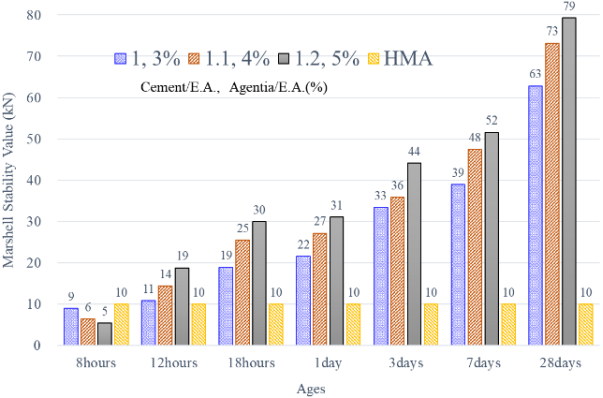
The CAC mixture shows better overall mechanical properties due to the proper proportion of material components. The strength trend of the Marshall stability value of CAC is shown in Figure 7. It is clear that the Marshall stability value of the CAC mixture is already higher than that of the HMA mixture at 12 hours of age, and it is at least 6 times higher at 28 days of age. Fang et al. (2016) reported a 20~30kN Marshall stability value of CAC in past studies
[24]
Xing Fang, Alvaro Garcia, Frank Winnefeld, Manfred N. Partl, Pietro Lura, 2016. “Impact of rapid-hardening cements on mechanical properties of cement bitumen emulsion asphalt.” Materials and Structures, 49: 487–498.
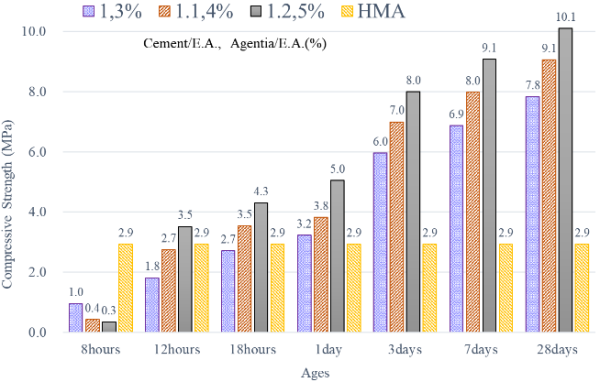
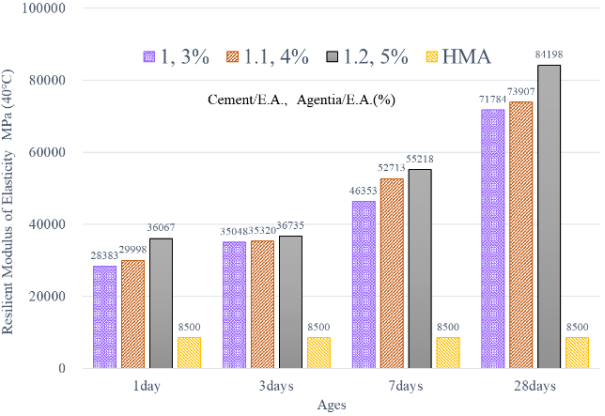
, while the result of this study is 2~3 times higher. As shown in Figure 8, the compressive strength of the CAC mixture at 1 day of age catches up with that of the HMA, and at 28 days, it is three times more than the HMA strength. A comparison of the resilient modulus is shown in Figure 9, and it is clear that the 40°C resilient modulus of the CAC mixture after 1 day can reach three times that of the HMA mixture, and eight times that of the HMA mixture at 28 days.
Figure 9. Modified Quality Performance of Resilient Modulus of CAC at 40°C.
4. Conclusions
The following conclusions can be drawn:
1) In previous studies
[13]
Jinhai Yan, Zhen Leng, Feng Li, Haoran Zhu, Shihui Bao, 2017. “Early-age strength and long-term performance of asphalt emulsion cold recycled mixes with various cement contents.” Construction and Building Materials, Volume 137, Pages 153-159.
Shaowen Du, 2018. “Effect of curing conditions on properties of cement asphalt emulsion mixture.” Construction and Building Materials, Volume 164, Pages 84-93.
Monica Meocci, Andrea Grilli, Francesca La Torre, Maurizio Bocci, 2017. “Evaluation of mechanical performance of cement–bitumen-treated materials through laboratory and in-situ testing.” Road Materials and Pavement Design, Volume 18, Issue 2, 376–389.
Bohdan Dolzycki, Mariusz Jaczewski, Cezary Szydlowski, 2017. “The long-term properties of mineral-cement-emulsion mixtures.” Construction and Building Materials, Volume 156, Pages 799-808.
, and during the preparation of cement asphalt concrete, the cement slurry was made from blending the cement in the emulsified asphalt with the addition of water. However, this study presented a significantly different approach of pretreated CAM, where the SNF molecules protect the CRS-1 micelles, and the cement can be blended directly with the CRS-1 and SNF. The use of SNF also reduces the CAM’s viscosity and provides good workability for the CAC mixture. For those mixtures with the slow-setting emulsified asphalt (CSS) blended with the cement, the gels in the CSS cannot provide good workability, and only increase the denseness and viscosity of the mastic. Therefore, it is necessary to blend the cement with water to synthesize the cement slurry, and then it can be blended with the CSS to yield better workability.
2) In this study, the CAC mixtures construction procedure is similar to that of the HMA mixtures. This approach is different from that described in previous literature about cement asphalt concrete constructing as Bohdan Dolzycki et al. (2007) concluded. The previous cement asphalt concrete constructing of Bohdan Dolzycki needs to be compacted in two stages. The first stage is preliminary compaction, and a waiting period of about 4 hours is required to allow the water to bleed from the cement asphalt concrete of past studies. The final compaction can be carried out after this this waiting period. However, the compaction procedure of the pretreated CAC mixture produced in this study is similar to that of HMA mixtures. The preliminary compaction stage, the continuous compaction stage, and the final compaction stage are continuously performed at one time.
3) Although SNF addition cannot directly increase the strength of the CAC mixture, it enhances the workability of pretreated CAM, and hence increases the cement proportion as well as the mechanical strength. Based on the results of this study, using SNF allows CRS-1 to be blended directly with cement in a cement/CRS-1 ratio of 1 to 1.2 by weight. This breaks the upper limits reported in previous studies
[13]
Jinhai Yan, Zhen Leng, Feng Li, Haoran Zhu, Shihui Bao, 2017. “Early-age strength and long-term performance of asphalt emulsion cold recycled mixes with various cement contents.” Construction and Building Materials, Volume 137, Pages 153-159.
Shaowen Du, 2018. “Effect of curing conditions on properties of cement asphalt emulsion mixture.” Construction and Building Materials, Volume 164, Pages 84-93.
Monica Meocci, Andrea Grilli, Francesca La Torre, Maurizio Bocci, 2017. “Evaluation of mechanical performance of cement–bitumen-treated materials through laboratory and in-situ testing.” Road Materials and Pavement Design, Volume 18, Issue 2, 376–389.
Bohdan Dolzycki, Mariusz Jaczewski, Cezary Szydlowski, 2017. “The long-term properties of mineral-cement-emulsion mixtures.” Construction and Building Materials, Volume 156, Pages 799-808.
. Finally, the mechanical strength of the manufactured pretreated CAC mixture has been significantly improved.
Abbreviations
CAM
Convenient Asphalt Mastic
CRS
Cationic Rapid Setting emulsified asphalt
CAC
Convenient Asphalt Concrete
SNF
Sulphonated Naphthalene Formaldehyde Condensates
HMA
Hot Mixture Asphalt
VOC
Volatile Organic Compounds
CSS
Cationic Slow Setting Emulsified Asphalt
ASTM
American Society of Testing Materials
Author Contributions
Cheng Tsung Lu: Conceptualization, Data curation, Methodology, Writing – original draft, Writing – review & editing
Ming Yan Chung: Resources, Supervision, Funding acquisition, Project administration
Data Availability Statement
The data is available from the corresponding author upon reasonable request.
The data supporting the outcome of this research work has been reported in this manuscript.
Conflicts of Interest
The authors declare no conflicts of interest.
References
[1]
Mihai O. Marasteanu and Timothy R. Clyne, 2006. “Rheological Characterization of Asphalt Emulsions Residues.” Journal of Materials in Civil Engineering, Volume 18 Issue 3, 398-407.
ZHU Xiaobin, HONG Jinxiang, LI Wei, Aug. 2017. “Effect of Demulsification Behavior of Emulsified Asphalt on Rheological Properties in CA Paste and Its Mechanism.” Journal of Building Materials, Vol. 20, No. 4: 548-555.
Ambarish Banerjee, Amit Bhasin, Jorge Prozzi, January 2013. “Characterizing Stability of Asphalt Emulsions Using Electrokinetic Techniques.” Journal of Materials in Civil Engineering, Volume 25, Issue 1 (78 - 85).
Xuepeng Cao, Cuihong Zhang, Shuaihua Tuo, Yao Fu, June 2021. “Influences on Compaction of Cold Mix Cement Emulsified Asphalt Using the Superpave Gyratory Compaction.” Journal of Materials in Civil Engineering, Volume 33, Issue 6.
Brown S F, Needham D, 2000. “A Study of Cement Modified Bitumen Emulsion Mixtures. ” Proceedings of the Association of Asphalt Paving Technologists, p. 92-121.
Oruc S, Celik F, Akpinar M V, 2007. “Effect of cement on emulsified asphalt mixtures.” Journal of Materials Engineering and Performance, 16(5): 578-583.
Andrea Grilli, Fabrizio Cardone, Edoardo Bocci, 2018. “Mechanical behaviour of cement-bitumen treated materials containing different amounts of reclaimed asphalt.” European Journal of Environmental and Civil Engineering, Volume 22, Issue 7 Pages 836-851.
R. Schmidt, L. Santucci, L. Coyne, 1973. “Performance characteristics of cement-modified asphalt emulsion mixes.” Association of Asphalt Paving Technologists Proc, Volume: 42, pp. 300-319, Proceedings of the meeting held in Houston, Texas.
[10]
Y. Niazi, M. Jalili, 2009. “Effect of Portland cement and lime additives on properties of cold in-place recycled mixtures with asphalt emulsion.” Construction and Building Materials, Volume 23, Issue 3, March, Pages 1338-1343.
M. Bocci, A. Grilli, F. Cardone, A. Graziani, 2011. “A study on the mechanical behaviour of cement–bitumen treated materials.” Construction and Building Materials, Volume 25, Issue 2, Pages 773-778.
Mojtaba ShojaeiBaghini, AmiruddinIsmail, Mohamed RehanBin Karim, 2015. “Evaluation of cement-treated mixtures with slow setting bitumen emulsion as base course material for road pavements.” Construction and Building Materials, Volume 94, Pages 323-336.
Jinhai Yan, Zhen Leng, Feng Li, Haoran Zhu, Shihui Bao, 2017. “Early-age strength and long-term performance of asphalt emulsion cold recycled mixes with various cement contents.” Construction and Building Materials, Volume 137, Pages 153-159.
Shaowen Du, 2018. “Effect of curing conditions on properties of cement asphalt emulsion mixture.” Construction and Building Materials, Volume 164, Pages 84-93.
Monica Meocci, Andrea Grilli, Francesca La Torre, Maurizio Bocci, 2017. “Evaluation of mechanical performance of cement–bitumen-treated materials through laboratory and in-situ testing.” Road Materials and Pavement Design, Volume 18, Issue 2, 376–389.
Bohdan Dolzycki, Mariusz Jaczewski, Cezary Szydlowski, 2017. “The long-term properties of mineral-cement-emulsion mixtures.” Construction and Building Materials, Volume 156, Pages 799-808.
LI Yuanyuan LI Chuangmin LIU An, 2015. “Study on Molding Methods and Compressive Strength of Cement-emulsified Asphalt Mixture with Coupling Agent.” Journal of Wuhan University of Technology, Vol. 39 No. 6, 1215-1220.
I Nyoman Arya Thanaya, I Nyoman Widana Negara, I Putu Suarjana, 2014. Properties of Cold Asphalt Emulsion Mixtures (CAEMs) using materials from old road pavement milling, Procedia Engineering, Volume 95, Pages 479-488.
Jozua Laven, Hans N. Stein, 2001. “The Electroviscous Behavior of Aqueous Dispersions of Amorphous Silica (Ludox).” Journal of Colloid and Interface Science, Volume 238, Issue 1, Pages 8-15.
Xing Fang, Alvaro Garcia, Frank Winnefeld, Manfred N. Partl, Pietro Lura, 2016. “Impact of rapid-hardening cements on mechanical properties of cement bitumen emulsion asphalt.” Materials and Structures, 49: 487–498.
Lu, C. T., Chung, M. Y. (2025). Pretreatment and Modification Effects of Convenient Asphalt Concrete. Journal of Civil, Construction and Environmental Engineering, 10(2), 81-89. https://doi.org/10.11648/j.jccee.20251002.14
Lu, C. T.; Chung, M. Y. Pretreatment and Modification Effects of Convenient Asphalt Concrete. J. Civ. Constr. Environ. Eng.2025, 10(2), 81-89. doi: 10.11648/j.jccee.20251002.14
Lu CT, Chung MY. Pretreatment and Modification Effects of Convenient Asphalt Concrete. J Civ Constr Environ Eng. 2025;10(2):81-89. doi: 10.11648/j.jccee.20251002.14
@article{10.11648/j.jccee.20251002.14,
  author = {Cheng Tsung Lu and Ming Yan Chung},
  title = {Pretreatment and Modification Effects of Convenient Asphalt Concrete
},
  journal = {Journal of Civil, Construction and Environmental Engineering},
  volume = {10},
  number = {2},
  pages = {81-89},
  doi = {10.11648/j.jccee.20251002.14},
  url = {https://doi.org/10.11648/j.jccee.20251002.14},
  eprint = {https://article.sciencepublishinggroup.com/pdf/10.11648.j.jccee.20251002.14},
  abstract = {The convenient asphalt mastic (CAM) is prepared by the pretreatment process of cationic rapid setting emulsified asphalt (CRS-1) with cement. The CAM is then mixed with the aggregate to produce the convenient asphalt concrete (CAC) mixture. The pretreatment is to mix sulphonated naphthalene formaldehyde condensates (SNF) with emulsified asphalt evenly. In the pretreatment process, the SNF generates a protective barrier outside the electrical double layer on the surface of the emulsified asphalt micelles, which can inhibit the demulsification of micelles and improve the stability of CRS-1 in the CAM preparation. The residual SNF in the pretreatment proceeding can also be used as a water reducing agent, which can improve the workability of CAM and provide a dosage ratio that can increase the cement content. The increase of cement content in CAM can significantly improve the mechanical properties of CAC. The results of this study show that as the SNF pretreatment dosage increases, CAM viscosity decreases, and the CAC mixture has better workability. The Marshall stability value of the CAC obtained by CRS-1 (pretreated with SNF) can reach about six times that of hot mixture asphalt (HMA) at 28 days of age. The compressive strength can reach more than three times and the 40°C resilient modulus can reach more than eight times. Clearly, the modification effect of the pretreated CAC significantly enhances the mechanical performance.
},
 year = {2025}
}
TY  - JOUR
T1  - Pretreatment and Modification Effects of Convenient Asphalt Concrete

AU  - Cheng Tsung Lu
AU  - Ming Yan Chung
Y1  - 2025/04/29
PY  - 2025
N1  - https://doi.org/10.11648/j.jccee.20251002.14
DO  - 10.11648/j.jccee.20251002.14
T2  - Journal of Civil, Construction and Environmental Engineering
JF  - Journal of Civil, Construction and Environmental Engineering
JO  - Journal of Civil, Construction and Environmental Engineering
SP  - 81
EP  - 89
PB  - Science Publishing Group
SN  - 2637-3890
UR  - https://doi.org/10.11648/j.jccee.20251002.14
AB  - The convenient asphalt mastic (CAM) is prepared by the pretreatment process of cationic rapid setting emulsified asphalt (CRS-1) with cement. The CAM is then mixed with the aggregate to produce the convenient asphalt concrete (CAC) mixture. The pretreatment is to mix sulphonated naphthalene formaldehyde condensates (SNF) with emulsified asphalt evenly. In the pretreatment process, the SNF generates a protective barrier outside the electrical double layer on the surface of the emulsified asphalt micelles, which can inhibit the demulsification of micelles and improve the stability of CRS-1 in the CAM preparation. The residual SNF in the pretreatment proceeding can also be used as a water reducing agent, which can improve the workability of CAM and provide a dosage ratio that can increase the cement content. The increase of cement content in CAM can significantly improve the mechanical properties of CAC. The results of this study show that as the SNF pretreatment dosage increases, CAM viscosity decreases, and the CAC mixture has better workability. The Marshall stability value of the CAC obtained by CRS-1 (pretreated with SNF) can reach about six times that of hot mixture asphalt (HMA) at 28 days of age. The compressive strength can reach more than three times and the 40°C resilient modulus can reach more than eight times. Clearly, the modification effect of the pretreated CAC significantly enhances the mechanical performance.

VL  - 10
IS  - 2
ER  -
Lu, C. T., Chung, M. Y. (2025). Pretreatment and Modification Effects of Convenient Asphalt Concrete. Journal of Civil, Construction and Environmental Engineering, 10(2), 81-89. https://doi.org/10.11648/j.jccee.20251002.14
Lu, C. T.; Chung, M. Y. Pretreatment and Modification Effects of Convenient Asphalt Concrete. J. Civ. Constr. Environ. Eng.2025, 10(2), 81-89. doi: 10.11648/j.jccee.20251002.14
Lu CT, Chung MY. Pretreatment and Modification Effects of Convenient Asphalt Concrete. J Civ Constr Environ Eng. 2025;10(2):81-89. doi: 10.11648/j.jccee.20251002.14
@article{10.11648/j.jccee.20251002.14,
  author = {Cheng Tsung Lu and Ming Yan Chung},
  title = {Pretreatment and Modification Effects of Convenient Asphalt Concrete
},
  journal = {Journal of Civil, Construction and Environmental Engineering},
  volume = {10},
  number = {2},
  pages = {81-89},
  doi = {10.11648/j.jccee.20251002.14},
  url = {https://doi.org/10.11648/j.jccee.20251002.14},
  eprint = {https://article.sciencepublishinggroup.com/pdf/10.11648.j.jccee.20251002.14},
  abstract = {The convenient asphalt mastic (CAM) is prepared by the pretreatment process of cationic rapid setting emulsified asphalt (CRS-1) with cement. The CAM is then mixed with the aggregate to produce the convenient asphalt concrete (CAC) mixture. The pretreatment is to mix sulphonated naphthalene formaldehyde condensates (SNF) with emulsified asphalt evenly. In the pretreatment process, the SNF generates a protective barrier outside the electrical double layer on the surface of the emulsified asphalt micelles, which can inhibit the demulsification of micelles and improve the stability of CRS-1 in the CAM preparation. The residual SNF in the pretreatment proceeding can also be used as a water reducing agent, which can improve the workability of CAM and provide a dosage ratio that can increase the cement content. The increase of cement content in CAM can significantly improve the mechanical properties of CAC. The results of this study show that as the SNF pretreatment dosage increases, CAM viscosity decreases, and the CAC mixture has better workability. The Marshall stability value of the CAC obtained by CRS-1 (pretreated with SNF) can reach about six times that of hot mixture asphalt (HMA) at 28 days of age. The compressive strength can reach more than three times and the 40°C resilient modulus can reach more than eight times. Clearly, the modification effect of the pretreated CAC significantly enhances the mechanical performance.
},
 year = {2025}
}
TY  - JOUR
T1  - Pretreatment and Modification Effects of Convenient Asphalt Concrete

AU  - Cheng Tsung Lu
AU  - Ming Yan Chung
Y1  - 2025/04/29
PY  - 2025
N1  - https://doi.org/10.11648/j.jccee.20251002.14
DO  - 10.11648/j.jccee.20251002.14
T2  - Journal of Civil, Construction and Environmental Engineering
JF  - Journal of Civil, Construction and Environmental Engineering
JO  - Journal of Civil, Construction and Environmental Engineering
SP  - 81
EP  - 89
PB  - Science Publishing Group
SN  - 2637-3890
UR  - https://doi.org/10.11648/j.jccee.20251002.14
AB  - The convenient asphalt mastic (CAM) is prepared by the pretreatment process of cationic rapid setting emulsified asphalt (CRS-1) with cement. The CAM is then mixed with the aggregate to produce the convenient asphalt concrete (CAC) mixture. The pretreatment is to mix sulphonated naphthalene formaldehyde condensates (SNF) with emulsified asphalt evenly. In the pretreatment process, the SNF generates a protective barrier outside the electrical double layer on the surface of the emulsified asphalt micelles, which can inhibit the demulsification of micelles and improve the stability of CRS-1 in the CAM preparation. The residual SNF in the pretreatment proceeding can also be used as a water reducing agent, which can improve the workability of CAM and provide a dosage ratio that can increase the cement content. The increase of cement content in CAM can significantly improve the mechanical properties of CAC. The results of this study show that as the SNF pretreatment dosage increases, CAM viscosity decreases, and the CAC mixture has better workability. The Marshall stability value of the CAC obtained by CRS-1 (pretreated with SNF) can reach about six times that of hot mixture asphalt (HMA) at 28 days of age. The compressive strength can reach more than three times and the 40°C resilient modulus can reach more than eight times. Clearly, the modification effect of the pretreated CAC significantly enhances the mechanical performance.

VL  - 10
IS  - 2
ER  -





 Share This Article
 Twitter
 Linked In
 Facebook
 Copy
Copy Download